
|

|

|

|

|

|
Home
About
Resources
anti-aging vitamins books
- A New Approach...
- The Exodus Happened 2450 B.C.
- Noah's Flood Happened 3520 B.C.
- Age of the Earth Collection
- Aging: Cause and Cure
- Bread from Heaven: The Manna Mystery Solved
newsletters
podcast
speaker for an event
time charts
videos
Topics
Overview
Biblical Chronology Dendrochronology Radiocarbon Dating Mt. Sinai Jericho Ai The Exodus Noah's Ark Imhotep/Joseph
Correspondence
- anti-aging vitamins
- antiquity of mankind
- ark search
- Bible chronology
- "The BC" publication
- Bryant Wood's critique
- calendars
- Heshbon
- horses and chariots in Egypt
- Jericho --- Joshua's curse
- lifespan research
- missing millennium: reception
- missing millennium: textual
- Mt. Sinai
- Noah's Flood
- Philistines
- radiocarbon
- Sodom and Gomorrah
- teaching science and creation
- the Exodus
- tree rings
- virtual history
- young earth creation
Contact Us
How does the radiocarbon dating method work?The following article is primarily based on a discussion of radiocarbon dating found in The Biblical Chronologist Volume 5, Number 1. Full details and references can be found there.Radiocarbon dating is based on a few relatively simple principles. There are many carbon atoms in our environment. The vast majority of these are 12C (pronounced "c twelve"), the stable isotope of carbon. However, cosmic radiation constantly collides with atoms in the upper atmosphere. Part of the result of these collisions is the production of radiocarbon (14C, pronounced "c fourteen"), carbon atoms which are chemically the same as stable carbon, but have two extra neutrons. Radiocarbon is not stable; over time radiocarbon atoms decay into nitrogen atoms. This tendency to decay, called radioactivity, is what gives radiocarbon the name radiocarbon. The atmosphere contains many stable carbon atoms and relatively few radiocarbon atoms. The ratio of radiocarbon to stable carbon atoms in the atmosphere has varied in the past. This is because the amount and strength of cosmic radiation entering the earth's atmosphere has varied over time. (This, in turn, is caused by variations in the magnetic fields of the earth and sun, for example.) Although the ratio of radiocarbon to stable carbon in the atmosphere has varied over time, it is quite uniform around the globe at any given time because the atmosphere mixes very quickly and constantly. Plants obtain all their carbon atoms from the atmosphere. Thus, the ratio of radiocarbon to stable carbon in a living plant is the same as the ratio of radiocarbon to stable carbon in the atmosphere at any given time. Animals (and humans) get their carbon atoms primarily from what they eat (i.e., plants). Thus the ratio of radiocarbon to stable carbon in living animal tissue is also virtually the same as the ratio of radiocarbon to stable carbon in the atmosphere at any given time. This ratio is the same for all organisms across the globe at a given time due to the mixing of the atmosphere mentioned above.
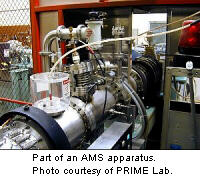
Radiocarbon dating works by precisely measuring the ratio of radiocarbon to stable carbon in a sample. This is done in one of three ways: 1. Gas Proportional Counting, 2. Liquid Scintillation Counting, and 3. Accelerator Mass Spectrometry. The purpose in each of these methods is to determine the ratio of radiocarbon to stable carbon in the sample. From this measurement the age in radiocarbon years is calculated.
Radiocarbon dating is a valuable tool to chronologists and archaeologists. It provides an objective, absolute method of determining a sample's age with quantifiable precision. Links & Credits
The foregoing article was primarily based on a discussion of radiocarbon dating found in The Biblical Chronologist Volume 5, Number 1. Full details and references can be found there. |
 When an organism dies (whether plant or animal) its intake of carbon atoms ceases. The starting ratio of radiocarbon to stable carbon is locked in at that point. From then on, the ratio of radiocarbon to stable carbon will decrease, because the unstable radiocarbon atoms will slowly decay. After about 50,000 years, the radiocarbon concentration remaining is too small to be measured for the purpose of radiocarbon dating.
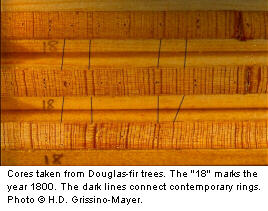 Then comes the important step of calibration. Modern radiocarbon dates are calibrated using long tree-ring chronologies. This is necessary to remove errors in raw radiocarbon dates caused by fluctuations in the amount of radiocarbon in the atmosphere in the past. The tree-ring chronologies have been constructed by counting the annual rings in living trees and matching patterns in these rings to older wood and dead trees. By cross-matching tree-ring sequences in individual specimens a long, continuous tree-ring chronology is constructed with very little dating uncertainty. (See